
How We Secured Planning Permission for a Loft Conversion to a New Build HMO in Enfield
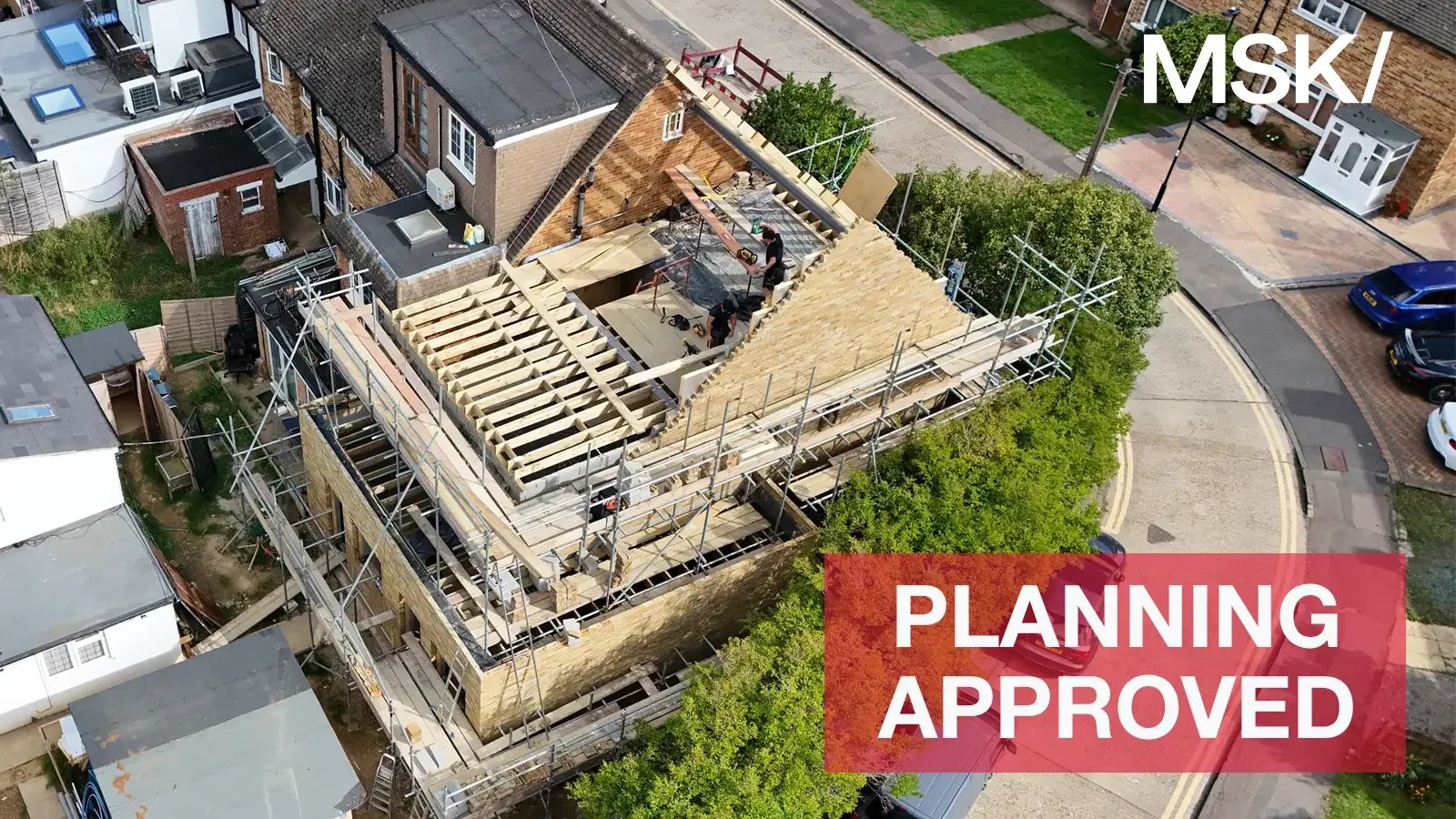
Securing planning permission for loft conversions to recently constructed properties can often be more complex than many homeowners and developers expect, particularly where permitted development rights have been removed or restricted.
At MSK Design Ltd, we secured full planning permission from Enfield Council for a rear dormer loft conversion and front rooflights at 2 Tudor Crescent, Enfield. The property operates as a new-build HMO, meaning the proposal required a carefully considered planning strategy rather than relying on standard permitted development rights.
This case study explains the key planning considerations, why full planning permission was required, and how a planning-led architectural approach helped secure approval.
What Was Proposed at Tudor Crescent?
The approved scheme involved alterations to the roof of the existing property to create additional habitable accommodation at loft level.
The proposal included:
A rear dormer loft conversion
Front rooflights
Internal reconfiguration of the upper floor accommodation
Additional living space within the existing building
A design approach that responded to the property’s new-build context and surrounding residential setting
The aim was to maximise the use of the existing roofspace while ensuring the proposal remained proportionate to the host building and acceptable in planning terms.
Do New Build Homes Have Permitted Development Rights for Loft Conversions?
Many homeowners assume that loft conversions automatically fall under permitted development rights. However, this is not always the case.
Permitted development rights can be removed or restricted through:
Planning conditions attached to earlier permissions
Article 4 Directions
New-build planning approvals
Conservation area constraints
Site-specific planning restrictions
Changes of use or property-specific planning history
For 2 Tudor Crescent, the property formed part of a new-build development where permitted development rights did not apply in the usual way. As a result, a full planning application was required for the proposed rear dormer and front rooflights.
This is an important point for homeowners, landlords and developers: before assuming a loft conversion can proceed under permitted development, the planning history of the property should always be checked carefully.
Planning Challenges for Loft Conversions in Enfield
Loft conversions and dormer extensions can raise several planning issues, particularly where they alter the shape, bulk or appearance of the roof.
For this project, the key planning considerations included:
The size and appearance of the rear dormer
The relationship between the dormer and the original roof form
The impact on the surrounding street scene
Privacy and overlooking
Neighbouring amenity
The visual impact of the front rooflights
The property’s status as a new-build HMO
Whether the proposal remained proportionate to the host building
Enfield Council will usually expect roof alterations to be carefully designed so that they do not appear overly dominant, poorly proportioned or harmful to the character of the area.
The planning strategy therefore focused on demonstrating that the loft conversion could provide additional accommodation while maintaining an acceptable relationship with the host property, neighbouring homes and the wider residential context.
How We Addressed Planning Policy
The design was developed to respond to local planning considerations relating to scale, massing, appearance and residential amenity.
Particular attention was given to:
Ensuring the rear dormer was appropriately proportioned
Maintaining a clear relationship with the existing roof form
Minimising visual dominance
Avoiding unacceptable overlooking
Preserving neighbouring amenity
Ensuring the front rooflights sat comfortably within the roof slope
Demonstrating that the proposal would not harm the character of the surrounding area
Rather than treating the loft conversion as a standard roof extension, the application needed to clearly justify why the proposal was acceptable on this specific site.
Through a planning-led design approach, the proposal demonstrated that the additional roof accommodation could be achieved without causing unacceptable harm to neighbouring properties or the appearance of the building.
Loft Conversions for HMOs and Shared Living Accommodation
Loft conversions can be an effective way of improving the functionality of HMO and shared living properties, particularly where there is existing unused roofspace.
However, HMO-related loft conversions often require additional care because they may need to address both planning and technical matters, including:
Internal layout
Occupancy arrangements
Fire safety
Means of escape
Room sizes
Natural light and outlook
Building Regulations compliance
Residential amenity standards
For landlords and developers, it is important to understand that obtaining planning permission is only one part of the process. A loft conversion must also be designed to comply with Building Regulations and fire safety requirements, particularly where the property is used as shared accommodation.
Early architectural and planning advice can help identify whether a proposal is achievable before significant time and cost is committed.
Why Early Planning Strategy Matters
This project demonstrates why early planning strategy is especially important for new-build homes, HMOs and properties with planning restrictions.
Before preparing a loft conversion application, it is important to review:
The original planning consent
Any planning conditions attached to the property
Whether permitted development rights have been removed
The relationship with neighbouring properties
The likely planning response to dormer size and roof alterations
The internal layout and Building Regulations implications
Whether the scheme is likely to be acceptable to the local planning authority
At MSK Design Ltd, we regularly begin projects by reviewing planning history, site constraints and design opportunities before progressing to a full planning application. This helps reduce planning risk and allows the design to be shaped around the specific requirements of the property.
For Tudor Crescent, this approach helped establish a clear planning route and supported the successful approval of the scheme.
Planning a Loft Conversion or HMO Project in Enfield?
MSK Design Ltd provides planning-led architectural design services for loft conversions, HMO projects and residential redevelopment schemes across Enfield, Barnet and North London.
Our services include:
Loft conversion design
Dormer extensions
Planning applications
HMO design and reconfiguration
Planning strategy and feasibility
Building Regulations packages
Residential redevelopment
We work with homeowners, landlords and developers to prepare carefully considered design proposals that balance planning policy, development potential and long-term building performance.
You can explore our related services here:
Planning Permission Services
Loft Conversion Design
Architect Planning Enfield
Residential Projects
Frequently Asked Questions
Do I need planning permission for a loft conversion in Enfield?
Some loft conversions can be carried out under permitted development rights, but this depends on the property, the scale of the works and any planning restrictions. Larger dormers, new-build properties, flats, HMOs, conservation constraints or properties with removed permitted development rights may require full planning permission.
Do new-build homes have permitted development rights?
Not always. Many new-build properties have planning conditions that remove or restrict permitted development rights. This means future extensions, roof alterations or outbuildings may require full planning permission.
Can an HMO have a loft conversion?
Yes, an HMO can have a loft conversion, subject to planning permission where required, Building Regulations compliance, fire safety, means of escape, room standards and overall residential amenity.
What does Enfield Council consider when assessing loft conversions?
Enfield Council will typically consider the size, scale and appearance of the dormer, the impact on the roof form, neighbouring amenity, privacy, overlooking, street scene impact and whether the proposal is appropriate for the property and surrounding area.
Can a rear dormer loft conversion still be approved if permitted development rights do not apply?
Yes, but a full planning application will usually be required. The proposal must demonstrate that the dormer is acceptable in design, scale, massing, appearance and neighbour impact.
Speak With a Planning-Led Architectural Practice in Enfield & North London
Whether you are considering a loft conversion, HMO project or residential redevelopment, early planning advice can significantly improve the success of a project.
At MSK Design Ltd, we assist homeowners, landlords and developers across Enfield, Barnet and North London with planning-led architectural design and development strategy.
To discuss your project, please contact MSK Design Ltd or explore our recent planning approvals and residential development case studies.