
How We Secured an Allowed Enforcement Appeal and Planning Permission in Hertsmere
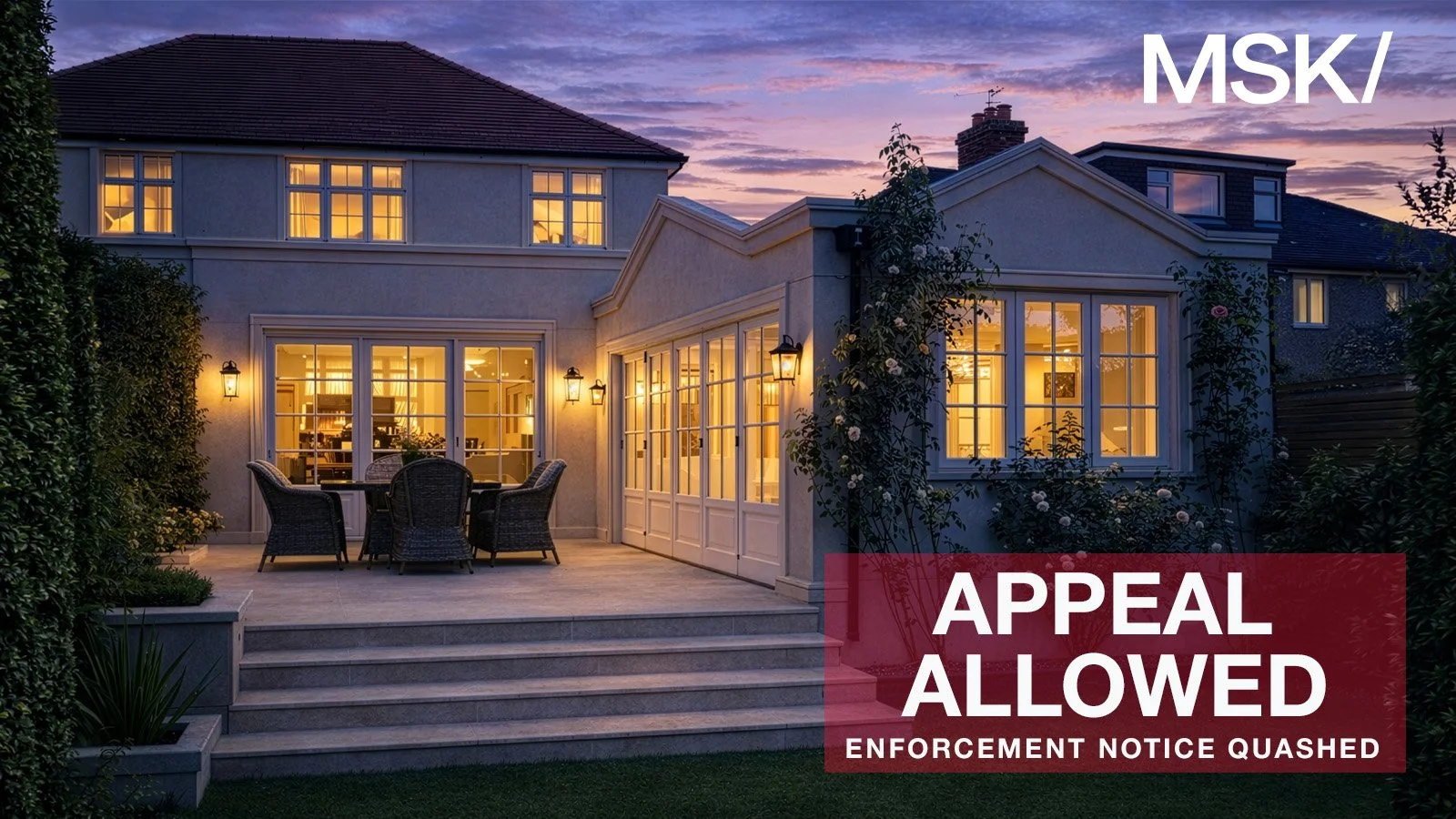
MSK Design Ltd helped secure a successful planning enforcement appeal for a residential property at Hill Rise, Hertsmere, resulting in the enforcement notice being quashed and planning permission being granted by the Planning Inspectorate.
The appeal related to a single-storey rear extension and associated patio. The Planning Inspectorate allowed the appeal and granted planning permission under section 177(5) of the Town and Country Planning Act 1990, under appeal reference APP/N1920/C/24/3352268.
This case study explains how a structured planning strategy, supported by permitted development analysis, lawful fallback arguments and a clear response to amenity and character concerns, helped achieve a successful outcome.
What Was the Enforcement Appeal About?
The local planning authority had issued an enforcement notice in relation to a single-storey rear extension and associated patio at the property.
The notice required:
removal of the rear extension;
removal or reduction of the patio;
reinstatement of the site.
An enforcement appeal was submitted under ground (a). This meant the appeal was assessed on whether planning permission should be granted for the development already carried out.
Under this route, the Planning Inspectorate considers a deemed planning application as part of the enforcement appeal process.
What Was the Outcome?
The Planning Inspectorate allowed the appeal.
The decision resulted in:
the enforcement notice being quashed;
planning permission being granted for the single-storey rear extension and patio;
the planning position of the site being formally regularised;
the threat of the required removal works being lifted.
This was a significant outcome for the client because the development was no longer unauthorised in planning terms and could remain in place.
Why the Planning Strategy Was Important
Planning enforcement cases are rarely straightforward.
Unlike a standard householder planning application, an enforcement appeal often requires a wider strategy that considers:
the wording of the enforcement notice;
the alleged breach of planning control;
whether the development is acceptable on planning merits;
whether any part of the development could be lawful;
whether permitted development rights are relevant;
whether there is a lawful fallback position;
whether a planning application or Certificate of Lawful Development can support the overall case;
how the development affects character, appearance and neighbouring amenity.
For this site, the appeal formed part of a wider coordinated planning strategy. That strategy included permitted development analysis, a lawful fallback position, a Certificate of Lawful Development and related planning applications.
This wider context helped demonstrate that the development should not be assessed in isolation, but against the realistic planning position of the site.
What Is a Ground (a) Enforcement Appeal?
A ground (a) enforcement appeal asks the Planning Inspectorate to grant planning permission for the development that is the subject of the enforcement notice.
In simple terms, the appellant is saying:
Even if planning permission was required, the development is acceptable and permission should now be granted.
This route is often used where the main issue is not whether the works physically exist, but whether they are acceptable in planning terms.
For this project, the appeal was assessed on the planning merits of the rear extension and patio, including their impact on character, appearance and neighbouring amenity.
Character and Appearance
One of the main issues considered by the Inspector was the effect of the development on the character and appearance of the area.
The council had raised concerns about the depth and scale of the rear extension. However, the surrounding area already included a pattern of rear extensions, outbuildings and extended built form.
The appeal case therefore focused on demonstrating that the extension did not appear out of keeping with its context.
The key points were:
the development sits to the rear of the property;
the surrounding area already includes rear extensions and outbuildings;
the extension is experienced within an established pattern of built form;
the proposal does not cause unacceptable harm to the character of the area;
the development remains acceptable when considered in its site-specific context.
The Inspector concluded that the development was acceptable in character and appearance terms.
Impact on Neighbouring Amenity
The second key issue was neighbouring amenity, particularly the relationship between the rear patio and adjoining properties.
In enforcement cases involving patios, terraces or raised platforms, councils often focus on whether the development causes unacceptable overlooking or loss of privacy.
For this appeal, the case demonstrated that the patio would not result in unacceptable harm to neighbouring privacy.
The key factors included:
existing boundary treatments;
fencing;
mature planting;
the way the patio is used;
the relationship with adjoining gardens;
the fact that the patio functions as a transitional rear garden space rather than an elevated viewing platform.
The Inspector concluded that the development would not cause unacceptable harm to neighbouring living conditions.
Why the Lawful Fallback Position Helped
A lawful fallback position can be an important material consideration in planning and enforcement appeals.
A fallback position is a form of development that could be carried out lawfully, either through permitted development rights, an existing planning permission or a Certificate of Lawful Development.
In this case, the wider planning strategy helped show that the site already had a relevant planning context. The development was not being considered against a blank canvas.
The fallback position helped frame the appeal by showing what could reasonably and lawfully take place at the property, and why the development being appealed should be considered acceptable in that context.
Planning Permission Granted by the Planning Inspectorate
The appeal decision did more than simply remove the enforcement notice.
Because the appeal was allowed under ground (a), the Planning Inspectorate also granted planning permission for the development.
This is an important distinction. The outcome was not only that enforcement action failed, but that the works received formal planning permission through the appeal process.
This provided the client with certainty and regularised the planning position of the rear extension and patio.
Why This Case Matters
This case demonstrates that enforcement action does not always mean a development must be removed.
Where a development can be justified on planning merits, and where the strategy is supported by a proper understanding of planning policy, permitted development rights and lawful fallback positions, there may be a route to a positive outcome.
The key lessons from this appeal are:
enforcement notices should be reviewed carefully;
appeal grounds need to be selected strategically;
planning merits still matter;
lawful fallback positions can be important;
amenity and character issues must be addressed clearly;
supporting evidence can make a significant difference;
enforcement cases benefit from early specialist advice.
Our Role
MSK Design Ltd provided planning and architectural support as part of the wider strategy for the site.
Our role included:
reviewing the planning history;
assessing the enforcement position;
considering permitted development and lawful fallback routes;
supporting the appeal strategy;
coordinating the planning case;
addressing design, character and amenity issues;
helping regularise the planning position of the site.
The appeal outcome builds on the wider planning work undertaken for the property and provides a clear example of how a coordinated planning strategy can resolve complex enforcement matters.
Planning Enforcement and Appeal Support
MSK Design Ltd provides planning-led architectural services for homeowners and property owners dealing with planning enforcement issues across Hertsmere, Barnet, Enfield and North London.
Our services include:
enforcement notice reviews;
enforcement appeal support;
retrospective planning applications;
lawful development certificates;
permitted development reviews;
lawful fallback position analysis;
planning strategy;
householder planning applications;
rear extension and patio regularisation;
coordination with planning consultants and appeal specialists.
We help clients understand whether development can be regularised, whether an appeal may be appropriate and what planning strategy gives the best chance of a successful outcome.
Frequently Asked Questions
What does it mean if an enforcement appeal is allowed?
If an enforcement appeal is allowed, the Planning Inspectorate has accepted the appeal grounds. Depending on the appeal ground, this can result in the enforcement notice being quashed, varied or corrected. In this case, the notice was quashed and planning permission was granted.
Can the Planning Inspectorate grant planning permission during an enforcement appeal?
Yes. Where an enforcement appeal is made under ground (a), the Planning Inspectorate can consider whether planning permission should be granted for the development. If the appeal succeeds, planning permission can be granted through the appeal decision.
What is a ground (a) enforcement appeal?
A ground (a) appeal argues that planning permission should be granted for the development alleged in the enforcement notice. It is effectively asking the Planning Inspectorate to assess the development on its planning merits.
Does an enforcement notice mean I have to remove the works immediately?
Not necessarily. An enforcement notice will usually specify a compliance period, and there may be a right of appeal. Once a valid appeal is submitted, the requirements of the notice are normally suspended until the appeal is determined.
Can a lawful fallback position help in an enforcement appeal?
Yes. A lawful fallback position can help show what could otherwise be built or retained lawfully. This can be relevant when assessing whether the development causes any additional planning harm.
What should I do if I receive an enforcement notice?
You should seek advice quickly. Enforcement notices have strict appeal deadlines, and missing the deadline can significantly limit your options. A review should consider the notice wording, appeal grounds, planning history, permitted development rights and whether a retrospective or appeal strategy is appropriate.
Dealing With a Planning Enforcement Notice?
If you have received an enforcement notice or are concerned about unauthorised works, early planning advice is important.
MSK Design Ltd can help review the enforcement position, assess your options and develop a strategy for regularising the development or responding to the notice.
To discuss your project, contact MSK Design Ltd or explore our planning permission and enforcement-related case studies.