
How MSK Design Secured Planning Permission for a Complex Rear Extension in Enfield
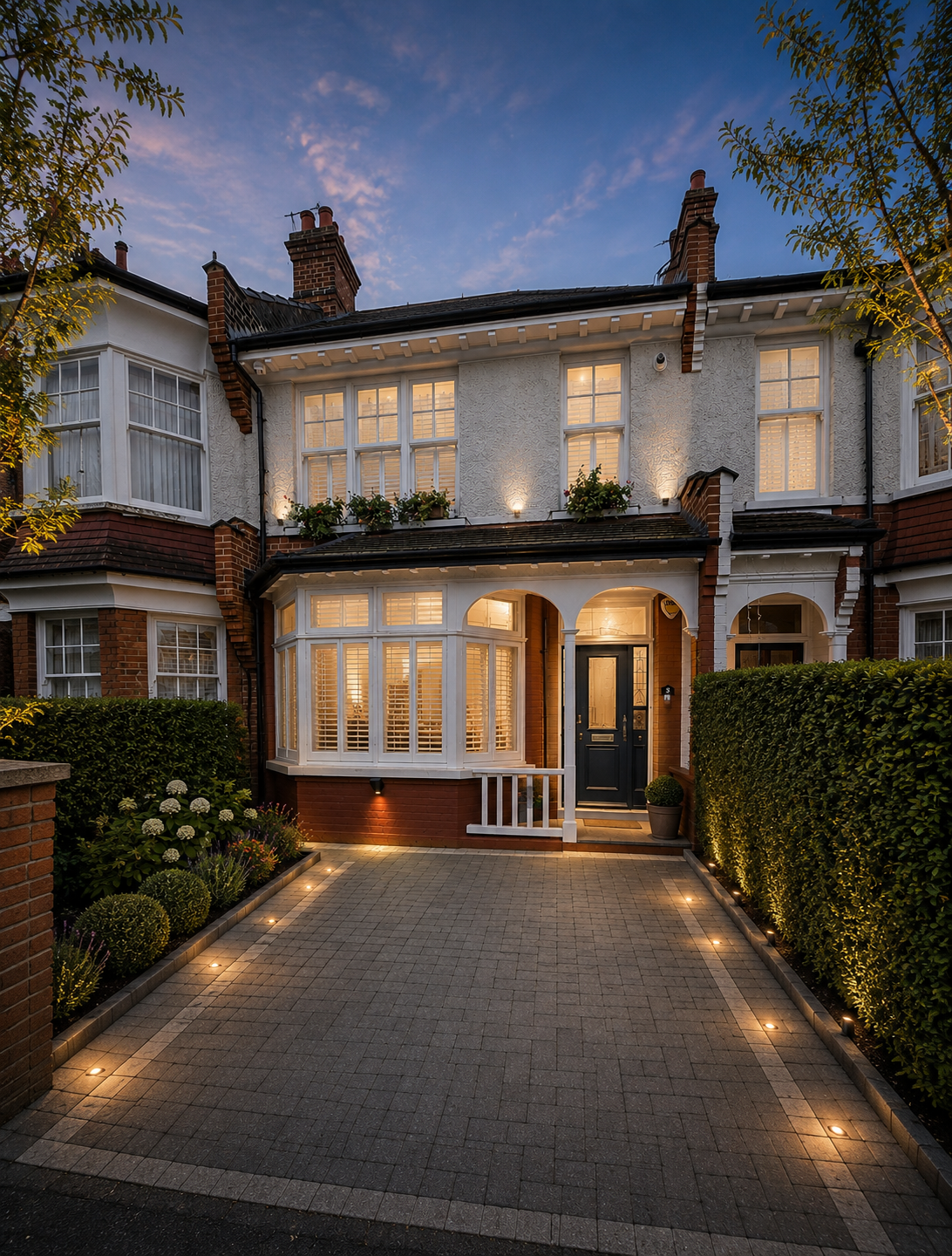
MSK Design has secured full planning permission for a complex single-storey rear extension at 3 Woodberry Avenue, London N21 3LE, within the London Borough of Enfield.
The proposal went beyond what would normally be expected for a standard rear extension under local planning policy. Rather than treating the application as a simple domestic addition, MSK Design prepared a full planning case explaining how the scheme addressed the intentions of local policy, protected neighbouring amenity and responded appropriately to the site’s constraints.
The application was led by Architect Monica Theo, with strategic planning oversight from Michael Koutra, Director of MSK Design. Enfield Council granted permission under reference 26/00719/FUL on 12 June 2026.
The approval demonstrates how careful architectural design, planning strategy and technical coordination can unlock consent for a more ambitious extension where the impact can be properly justified.
The brief: improving a constrained ground floor flat
The application site comprises a mid-terrace property on Woodberry Avenue which had previously been subdivided into two self-contained flats. The application related only to the ground floor flat, with no works proposed to the first-floor flat above.
The client’s objective was to improve the quality, functionality and long-term usability of the ground floor accommodation. The proposal sought to create approximately 20.2 square metres of additional floorspace, increasing the gross internal floor area to around 75.1 square metres and helping convert the existing one-bedroom flat into a more practical family-sized home.
The approved design provides an additional bedroom and improved living accommodation while incorporating an internal courtyard to promote outlook, daylight and natural ventilation to the inner rooms. This was an important part of the design strategy because the proposal needed to improve the accommodation without creating an unacceptable impact on neighbouring properties.
Why the planning application was complex
Many rear extensions are assessed against standard expectations for depth, height and relationship with adjoining properties. In this case, the proposed extension required a more detailed planning argument because of its projection, site context and relationship with neighbouring buildings.
The planning statement set out that the extension projected approximately 6.8 metres along the side adjoining the GP surgery at 1 Woodberry Avenue, inclusive of the internal courtyard, and approximately 4.95 metres along the side adjoining the neighbouring residential dwelling at 5 Woodberry Avenue.
The key challenge was to demonstrate that, although the proposal went beyond what local policy would normally permit in a standard assessment, it still addressed the intention of those policies. In practical terms, this meant showing that the extension would:
remain appropriate to the host property and wider terrace;
protect neighbouring amenity;
avoid unacceptable loss of outlook, daylight or sunlight;
avoid an overbearing relationship with neighbouring properties;
provide improved residential accommodation;
respond to site-specific constraints, including surface water flood risk.
MSK Design prepared a planning-led design strategy that addressed these points through the form, layout, stepping, courtyard arrangement and technical evidence submitted with the application.
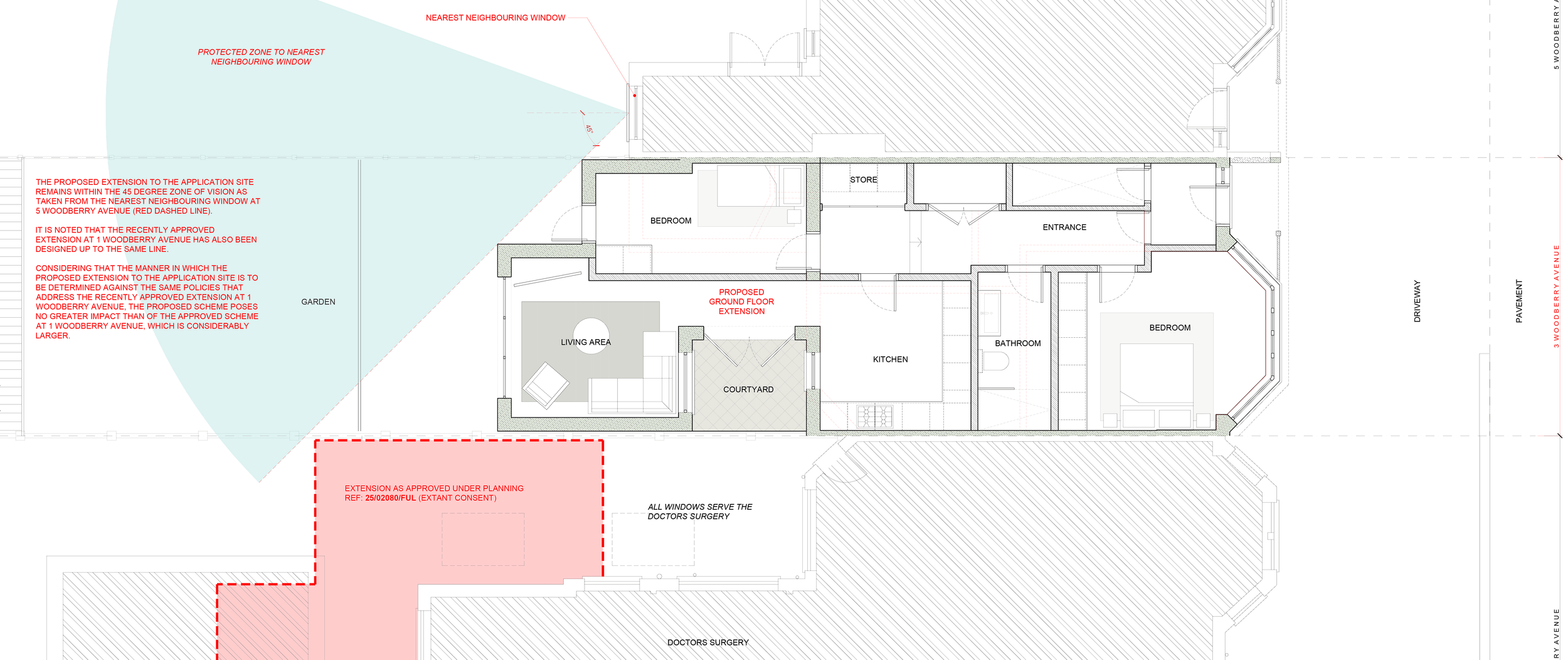
Proposed ground floor plan showing how MSK Design assessed the extension against the nearest neighbouring window, the 45-degree zone of vision and the approved fallback scheme at 1 Woodberry Avenue.
The proposed ground floor layout was developed around the neighbouring amenity constraints. MSK Design assessed the nearest neighbouring window at 5 Woodberry Avenue and demonstrated that the extension remained within the 45-degree zone of vision. The design also considered the approved extension at 1 Woodberry Avenue as a relevant planning context, showing that the proposed scheme would not create a greater amenity impact than the established fallback position.
A design strategy shaped by neighbouring amenity
One of the most important parts of the application was the relationship with the adjoining properties.
To the west, 5 Woodberry Avenue is a residential neighbour. The design was carefully assessed against the nearest neighbouring window, with the submitted proposed ground floor plan showing that the extension remained within the 45-degree zone of vision from that window. The drawing also explained that the proposed scheme posed no greater impact than the recently approved extension at 1 Woodberry Avenue, which was identified as a relevant planning context.
To the east, 1 Woodberry Avenue is a GP surgery rather than a residential dwelling. The planning statement explained that the ground floor windows serving the surgery do not serve habitable residential accommodation and are therefore less sensitive in amenity terms.
The proposed extension incorporated an internal courtyard adjacent to the boundary with No. 1. This created separation before the extension continued further into the rear garden, helping reduce the perceived bulk of the development and retain openness in the most sensitive part of the neighbouring relationship.
The officer’s report accepted this design logic. Enfield Council concluded that the proposal would not result in unacceptable harm to neighbouring amenity in terms of outlook, light or sense of enclosure. The report also recognised the relevance of the approved scheme at No. 1 as a fallback position when assessing the impact of the proposal.
Responding to local character and townscape
Woodberry Avenue is characterised by two-storey terraced properties with a varied pattern of rear extensions. The officer’s report noted that single-storey rear extensions are a common and well-established feature within the locality, with neighbouring properties already containing rear projections.
MSK Design’s proposal was developed as a single-storey rear addition with a flat roof and matching external materials. The proposed rear elevation shows the extension sitting to the rear of the property, while the front elevation remains unchanged.
Enfield Council found that the scale, form and siting of the development would not appear incongruous or visually harmful, and that matching materials would ensure a cohesive appearance. The proposal was considered to accord with relevant design policies, including London Plan Policy D3 and Enfield Development Management Document Policies DMD8 and DMD37.
This part of the decision is important. It shows that a proposal can sometimes go beyond normal extension expectations where the design response is carefully justified against the actual site context, neighbouring relationships and the wider pattern of development.
Technical coordination: addressing surface water flood risk
The application also required technical coordination because the site was affected by surface water flood risk constraints.
The Flood Risk Assessment identified that the site lies within Flood Zone 1, meaning it has a low probability of fluvial flooding. However, surface water mapping and the Enfield Strategic Flood Risk Assessment identified potential shallow ponding in the rear garden during higher rainfall events.
The assessment explained that surface water flooding was the only material source of flood risk affecting the site. It concluded that flood depths affecting the proposed extension were consistently shallow, generally less than 200mm, and that the proposal would not obstruct overland flow routes or increase flood risk elsewhere.
A precautionary finished floor level strategy was incorporated, with internal finished floor levels recommended at a minimum of 32.15mAOD, providing 300mm freeboard above the interpreted extreme surface water flood level of approximately 31.85mAOD.
The officer’s report recorded that SuDS officers raised no objection. It also noted that the proposed extension would sit on an area already paved with hardstanding and that the introduction of the extension was not expected to increase flood risk.
This was a key part of the consent. It demonstrates that planning success often depends not only on architectural drawings, but also on coordinating the right technical evidence to address local authority concerns.
Planning outcome
Enfield Council granted planning permission subject to conditions. The decision notice confirms that the approved plans included the location plan, existing and proposed block plans, existing and proposed site plans showing levels, existing and proposed roof plans, elevations, ground floor plans, sectional elevations, Flood Risk Assessment, Flood Risk Statement and Planning Statement.
The permission was also subject to a materials condition requiring all new external work to be carried out in materials that match the existing building or as specified in the approved application.
The approval allows the client to move forward with a more functional and family-suitable ground floor home, while maintaining an acceptable relationship with neighbouring properties and addressing the site’s technical flood risk considerations.
How MSK Design added value
This application is a strong example of MSK Design’s planning-led approach to residential architecture.
The value of the work was not simply in preparing drawings. The approval depended on a coordinated planning strategy that brought together design, policy justification, neighbour amenity analysis and technical flood risk evidence.
MSK Design added value by:
developing a carefully stepped rear extension layout;
incorporating an internal courtyard to support outlook, daylight and ventilation;
assessing the neighbouring relationship with 1 and 5 Woodberry Avenue;
using the approved scheme at No. 1 as relevant planning context;
preparing a planning statement that explained why the proposal met the intention of local policy;
coordinating technical evidence in response to surface water flood risk;
presenting a clear case that the development would not cause detrimental impact to surrounding properties or amenity.
The project was led by Architect Monica Theo and overseen by Michael Koutra, combining architectural design, planning strategy and technical coordination.
What homeowners can learn from this approval
Not every extension that exceeds standard policy expectations is automatically unacceptable. However, where a proposal goes beyond normal guidance, it usually needs a stronger planning case.
For homeowners and property owners, this approval highlights several important lessons:
First, the design must respond to the specific site. A larger extension is more likely to be considered acceptable where its form, height, depth and relationship to boundaries are carefully controlled.
Second, neighbouring amenity must be addressed clearly. Councils will assess outlook, daylight, sunlight, privacy and sense of enclosure. A strong submission should explain these issues rather than leave them to interpretation.
Third, planning policies should be addressed by purpose, not just by wording. In this case, the strategy was to show that the development met the underlying intention of the relevant policies, even though the extension went beyond what would usually be expected.
Finally, technical constraints should be dealt with early. Surface water flood risk, drainage and SuDS requirements can affect even relatively modest domestic extensions, especially where local mapping identifies flood risk.
Frequently Asked Questions
Can a rear extension go beyond normal local planning guidance?
Sometimes, but it depends on the site context, design quality, neighbouring relationships and the strength of the planning case. Where a proposal exceeds normal expectations, it needs to demonstrate that it still meets the underlying aims of local policy and does not cause unacceptable harm.
Why would a ground floor extension need full planning permission?
A ground floor extension may need full planning permission if it does not fall within permitted development rights, relates to a flat, exceeds relevant limits, affects neighbouring amenity, or involves site-specific planning constraints.
What does the council consider when assessing a rear extension?
The council will usually assess design, scale, height, depth, materials, impact on the host building, relationship with neighbouring properties, daylight, outlook, privacy, sense of enclosure, drainage and any site-specific constraints.
Can surface water flood risk affect a house extension?
Yes. Even where a property is in Flood Zone 1, local surface water mapping may identify risk during heavy rainfall events. In those cases, a Flood Risk Assessment, drainage strategy or SuDS measures may be required to demonstrate that the development is safe and will not increase flood risk elsewhere.
Can MSK Design help with complex extension planning applications in Enfield?
Yes. MSK Design prepares architectural drawings, planning statements and coordinated planning submissions for homeowners and property owners across Enfield, Barnet and North London.
Planning a ground floor extension in Enfield or North London?
If you are considering a ground floor rear extension, side extension, wraparound extension or more complex residential alteration in Enfield, Barnet or North London, MSK Design can help you understand the planning route before you commit to a submission.
A well-prepared application should do more than show what you want to build. It should explain why the proposal is acceptable in planning terms, how it responds to neighbouring properties, and how any technical constraints can be addressed.
Speak to MSK Design about your extension planning strategy.