
How We Secured Planning Permission to Support an Enforcement Appeal in Hertsmere
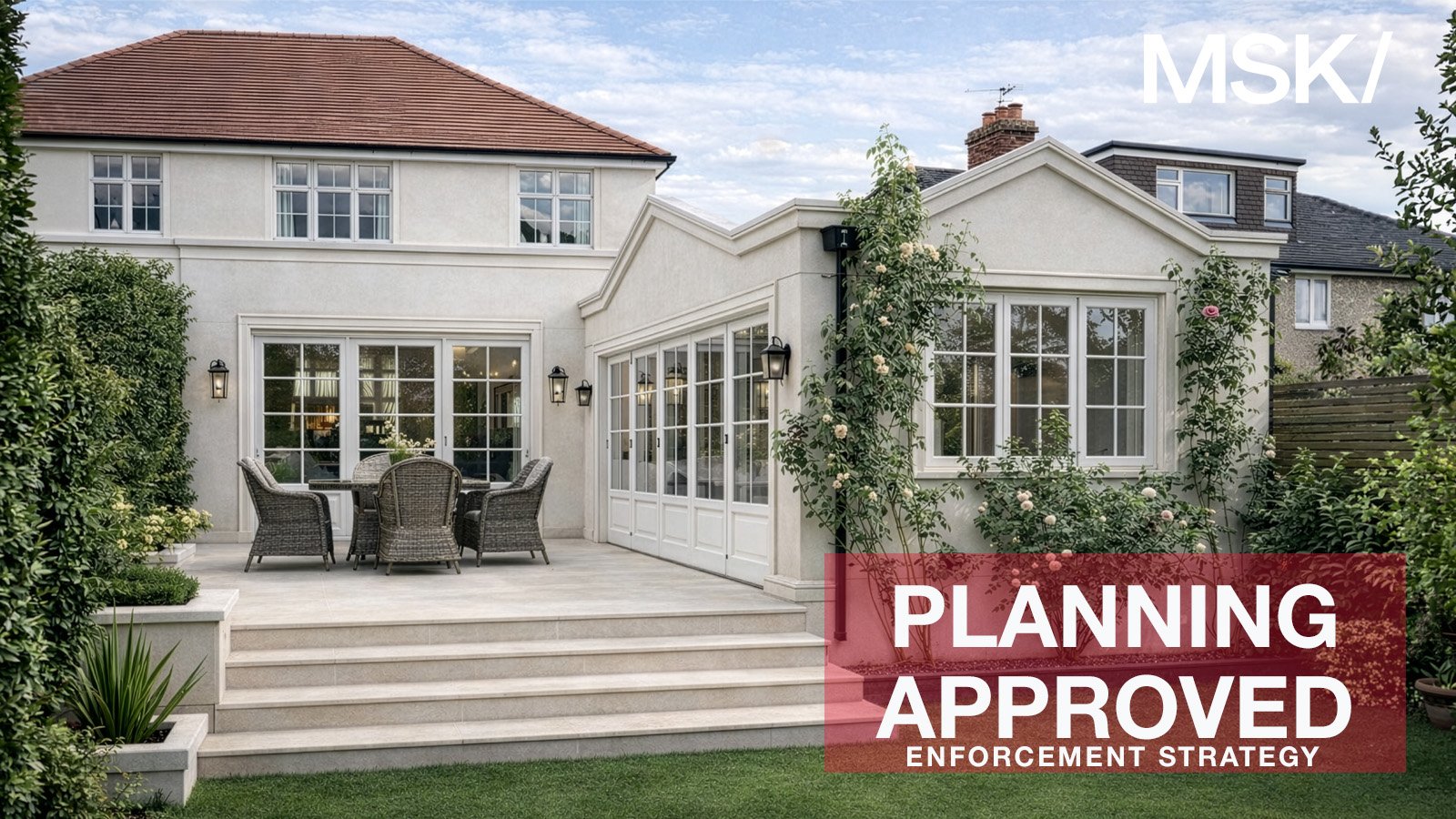
MSK Design Ltd secured planning permission from Hertsmere Borough Council for a rear infill extension at a residential property on Hill Rise, Hertsmere, forming part of a wider planning strategy to support an enforcement appeal and regularise development on the site.
The approved application, granted under reference 25/1296/HSE, was not submitted in isolation. It formed part of a coordinated approach involving permitted development rights, a lawful development fallback position and a targeted full planning application.
This case study explains how a layered planning strategy helped strengthen the overall planning position of the site, demonstrating the importance of understanding lawful fallback positions when responding to enforcement action.
What Was Proposed at Hill Rise, Hertsmere?
The approved proposal involved a rear infill extension designed to connect and rationalise existing and proposed rear development at the property.
The wider site strategy included:
A single-storey rear extension approved through prior approval
A replacement outbuilding secured under a Certificate of Lawful Development
A targeted rear infill extension submitted through a full planning application
Roof and terrace alterations forming part of the wider design approach
A coordinated response to an ongoing enforcement notice and appeal process
The purpose of the planning application was to address a specific linking element between forms of development that already had a lawful or fallback planning position.
This was important because the planning assessment was not simply about the overall depth of the rear development. It was also about whether the additional infill element caused any materially greater planning harm when considered against the established fallback position.
Why the Enforcement Context Was Important
Planning enforcement cases require a different approach from standard householder planning applications.
Where an enforcement notice has been issued, the planning strategy usually needs to consider:
The alleged breach of planning control
Whether parts of the development are already lawful
Whether permitted development rights apply
Whether a lawful fallback position exists
Whether a planning application can regularise part of the works
Whether an appeal strategy is required
Whether further evidence is needed to support the planning position
For this project, the planning application formed part of a wider strategy to rationalise the site and strengthen the client’s position in response to enforcement action.
Rather than relying only on retrospective justification, the approach focused on establishing what could lawfully be built and then using that position to inform the full planning application.
What Is a Lawful Fallback Position?
A lawful fallback position is an alternative form of development that could be carried out lawfully, either through permitted development rights, an existing planning permission or a Certificate of Lawful Development.
Fallback positions can be important in planning decisions because they help the local planning authority assess the real-world difference between:
what is being proposed; and
what could already be lawfully implemented.
In some cases, a proposal that may appear excessive in isolation can become more acceptable when assessed against a realistic fallback position.
At Hill Rise, the fallback position was central to the planning strategy because parts of the overall rear development could be delivered independently through lawful planning routes.
Clarifying Permitted Development Rights
A key part of the project involved reviewing the site’s permitted development position.
An earlier Certificate of Lawful Development application had been refused based on the local authority’s interpretation of the General Permitted Development Order. Following a technical review, MSK Design identified that the assessment did not fully reflect the correct application of the legislation.
Engagement with the planning authority at senior level helped clarify this position. As a result:
the matter was reconsidered;
the resubmission fee was waived by the Council; and
a Certificate of Lawful Development was subsequently granted.
This was a critical step because it established a stronger lawful fallback position, which then informed the acceptability of the wider planning strategy.
Why a Full Planning Application Was Still Required
Although parts of the development could be supported through permitted development and lawful development routes, not every element could be dealt with in that way.
The rear infill extension required a full planning application because it formed a linking element between the previously established rear extension and the replacement outbuilding.
The planning application therefore focused on whether this additional element would cause unacceptable harm in terms of:
neighbouring amenity;
character and appearance;
scale and massing;
visual impact;
outlook and privacy;
parking or access; and
the relationship with the lawful fallback position.
This targeted approach avoided treating the entire rear arrangement as if it were a fresh proposal with no planning context.
Navigating Policy Constraints
In isolation, the combined rear depth of development extending to approximately 12.6 metres would normally be difficult to support under typical residential extension guidance. The live blog notes that this depth would usually fall well beyond adopted planning guidance and would be unlikely to receive support if considered without context.
However, the planning authority recognised that the approved rear extension and lawful outbuilding could be implemented independently. The infill element was therefore assessed as a limited additional intervention rather than a wholly new 12.6 metre extension.
This demonstrates an important planning principle: the acceptability of a proposal can change significantly when the lawful fallback position is properly understood.
For enforcement and retrospective planning cases, this type of analysis can be critical.
Design Approach
The design focused on consolidating the rear built form into a coherent and functional arrangement.
The approved scheme included:
a rear infill element to connect the built form;
a mono-pitched roof to create a more unified appearance;
rationalised rear massing;
improved internal usability and flow;
a low visual impact from the public realm; and
a layout that responded to neighbouring amenity considerations.
Because the works were largely contained to the rear of the property, the assessment focused primarily on private amenity impact rather than wider streetscene harm.
The planning officer concluded that the proposal would not cause unacceptable impact in terms of character or neighbouring amenity.
Planning Outcome
Planning permission was granted under delegated powers by Hertsmere Borough Council.
The approval was important because it:
regularised a key part of the rear arrangement;
strengthened the client’s position in relation to the enforcement appeal;
confirmed the acceptability of the targeted infill element;
relied on a properly established fallback position;
addressed character and amenity considerations; and
supported a more coherent long-term planning position for the site.
No objections were received, and the live blog notes that no adverse impact was identified in relation to neighbouring amenity, parking or character.
Why Planning Strategy Matters in Enforcement Cases
Planning success is often driven by strategy, not just design.
This is especially true where a site is affected by enforcement action, previous applications, refused lawful development certificates or disputed permitted development rights.
A strong enforcement-related planning strategy may involve:
reviewing the enforcement notice;
analysing the planning history;
identifying lawful fallback positions;
checking permitted development rights;
preparing Certificate of Lawful Development applications;
submitting targeted planning applications;
coordinating appeal evidence; and
sequencing applications in the correct order.
In many cases, a single retrospective application is not enough. The strongest approach is often a structured planning strategy that separates lawful elements from those requiring express planning permission.
Planning Enforcement and Lawful Development Specialists
MSK Design Ltd provides planning-led architectural services for homeowners and property owners dealing with complex planning issues across Hertsmere, Barnet, Enfield and North London.
Our work includes:
planning enforcement strategy;
enforcement appeal support;
retrospective planning applications;
lawful development certificates;
permitted development reviews;
fallback position analysis;
householder planning applications;
rear extensions and outbuildings;
planning history reviews; and
architectural design for regularisation schemes.
We help clients understand what can be regularised, what can be supported through lawful development routes and how to structure a planning strategy that improves the chance of a successful outcome.
Frequently Asked Questions
What is a planning enforcement appeal?
A planning enforcement appeal is a formal appeal against an enforcement notice issued by a local planning authority. It allows the recipient to challenge the notice, argue that permission should be granted, or demonstrate that the alleged breach is lawful or should not be enforced.
Can planning permission help with an enforcement appeal?
Yes. In some cases, securing planning permission for part of the development can strengthen the overall planning position and help demonstrate that certain works are acceptable in planning terms.
What is a lawful fallback position?
A lawful fallback position is a form of development that could already be carried out lawfully, either through permitted development rights, an existing approval or a Certificate of Lawful Development. It can be a material consideration in planning decisions.
What is a Certificate of Lawful Development?
A Certificate of Lawful Development is a formal decision from the local planning authority confirming that proposed or existing works are lawful in planning terms. It is often used where a development is intended to rely on permitted development rights.
Can a retrospective planning application stop enforcement action?
A retrospective planning application may help regularise unauthorised development, but it does not automatically stop enforcement action. The correct approach depends on the enforcement notice, the planning history and whether an appeal or lawful development strategy is also required.
Why is planning strategy important in enforcement cases?
Planning enforcement cases often involve several overlapping issues, including planning history, permitted development rights, lawful fallback positions, evidence and appeal grounds. A strategic approach can help separate lawful elements from those that need planning permission and improve the overall case.
Dealing With a Planning Enforcement Issue?
If your property is affected by enforcement action, a refused lawful development certificate or a complex planning history, early advice can make a significant difference.
MSK Design Ltd can help review the planning position, identify lawful fallback options, prepare planning applications and support enforcement appeal strategies.
To discuss your project, contact MSK Design Ltd or explore our planning permission and enforcement-related case studies.