
How We Secured Planning Permission for a Flat Conversion and Roof Extension in Friern Barnet
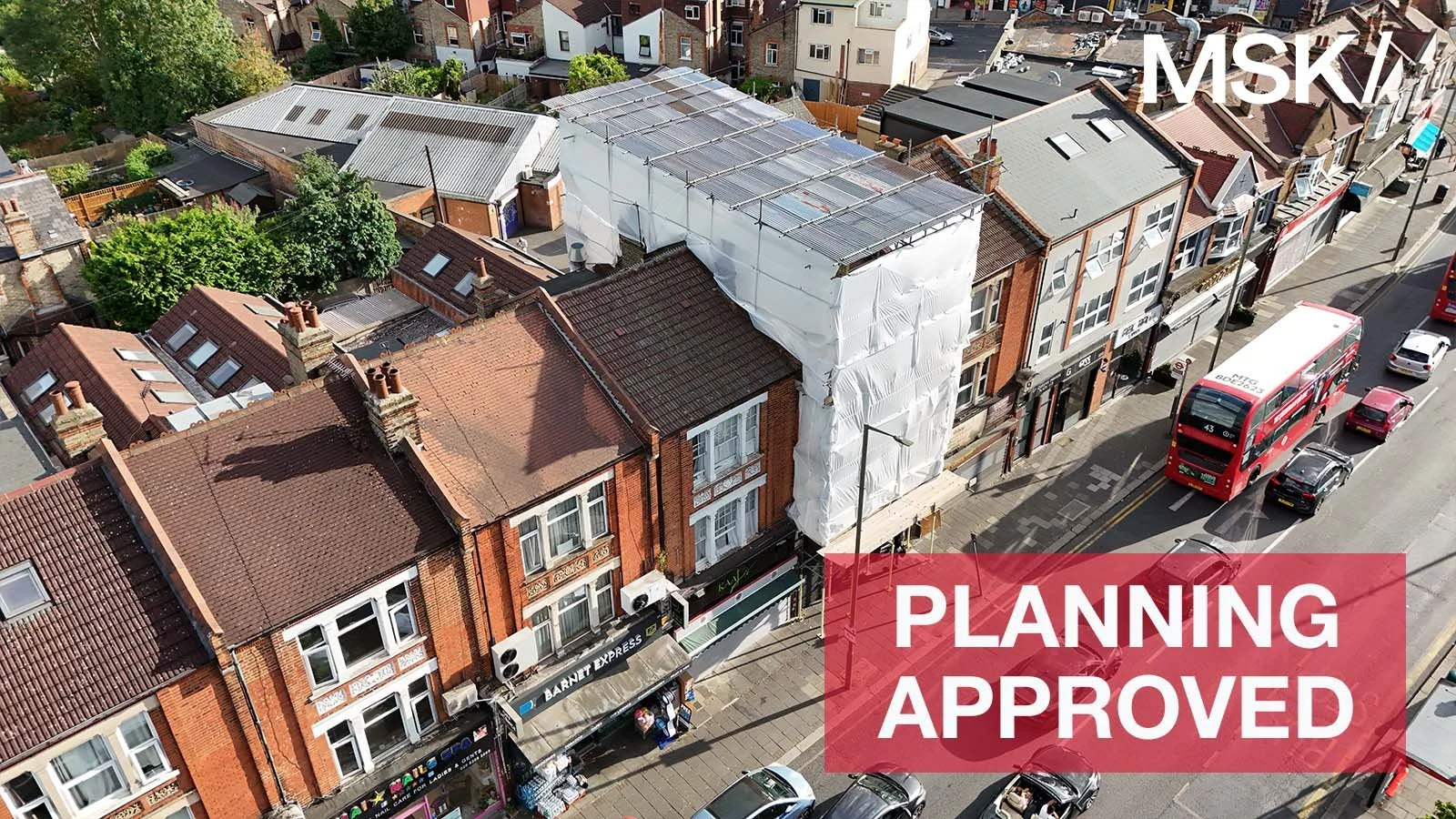
MSK Design Ltd secured planning permission from the London Borough of Barnet for the subdivision of an existing residential maisonette at 25A Queens Parade, Friern Barnet Road, N11 into two self-contained flats, together with a rear extension and roof alterations.
The approved scheme creates two 2-bedroom flats above an existing commercial ground floor unit within the Friern Barnet Local Centre. The project required a careful planning strategy due to the site’s mixed-use context, previous planning history, roof extension constraints, internal space standards and the need to demonstrate acceptable residential accommodation.
This case study explains how a policy-led design approach helped secure approval for a residential conversion and roof extension in Barnet.
What Was Proposed at 25A Queens Parade?
The application sought planning permission to convert the existing upper-floor residential accommodation into two self-contained flats while extending and altering the building to improve the available internal space.
The approved development includes:
Subdivision of the existing maisonette into two self-contained flats
A first-floor rear extension
Two rear dormer extensions
Two front rooflights
Internal reconfiguration to create two 2-bedroom flats
Four internal cycle storage spaces
A car-free development approach
The approved accommodation provides:
Flat 1 – 2-bedroom, 3-person flat
Flat 2 – 2-bedroom, 3-person flat
Following amendments during the application process, both flats were designed to meet London Plan minimum internal space standards and relevant ceiling height requirements.
Why the Planning History Was Important
One of the key challenges on this site was its planning history.
The property had previously been subject to planning refusals, including proposals involving more intensive roof alterations. This meant that the design strategy needed to be carefully informed by the council’s earlier concerns and the planning decisions already made on the building.
Rather than pursuing an overly intensive mansard-style approach, the approved scheme was developed around a more balanced roof extension strategy.
The planning approach focused on:
Reviewing previous planning refusals
Understanding the council’s earlier concerns
Aligning the roof design with previously approved extension forms
Avoiding excessive bulk and massing
Demonstrating compliance with Barnet’s residential conversion policies
Ensuring the proposed flats achieved acceptable living standards
This helped create a scheme that responded directly to the site’s planning constraints rather than simply maximising floor area.
Planning Challenges for Flat Conversions in Barnet
Converting an existing residential unit into multiple flats can raise several planning issues, particularly where the property is located above commercial premises or within a local centre.
For this project, the main planning considerations included:
Whether the principle of subdivision was acceptable
Compliance with Barnet’s residential conversion policy
Internal space standards
Ceiling heights
Outlook and daylight
Privacy and neighbouring amenity
Cycle storage
Parking and transport accessibility
The design and scale of roof alterations
The relationship with the existing mixed-use parade
Barnet Council’s Policy HOU03 is particularly important for residential conversions. Proposals must demonstrate that the converted units provide acceptable accommodation and do not result in harmful impacts on neighbouring properties or the wider area.
How the Scheme Addressed London Plan Space Standards
A key part of the planning process involved demonstrating that the proposed flats would provide suitable living accommodation for future occupants.
The internal layouts were amended during the application process to address:
Minimum gross internal area
Bedroom sizes
Ceiling height requirements
Layout efficiency
Natural light and outlook
Functional living space
The London Plan requires new homes to meet minimum internal space standards. For residential conversions, this can be challenging because the existing building structure, roof form and floor levels often restrict layout options.
At 25A Queens Parade, careful design coordination was required to make sure the final layouts achieved policy-compliant accommodation while working within the constraints of the existing building.
Roof Extension and Dormer Design Strategy
The approved scheme includes rear dormer extensions and front rooflights.
Roof extensions can be sensitive in planning terms because they may affect:
The appearance of the host building
The character of the surrounding parade
The roofscape
Neighbouring outlook and privacy
The perceived scale of development
Whether the proposal appears overly dominant
For this project, the roof alterations were designed to respond to the established character of the mixed-use parade and to reflect previously approved extension forms.
This approach helped avoid the issues associated with earlier, more intensive roof extension proposals and supported a more acceptable planning outcome.
Why the Friern Barnet Local Centre Location Helped
The site is located within the Friern Barnet Local Centre and has a PTAL rating of 3. This supported the principle of a car-free residential conversion because the site benefits from access to local shops, services and public transport.
In planning terms, local centre locations can be suitable for residential intensification where proposals make efficient use of existing buildings and provide acceptable accommodation.
For this scheme, the car-free approach was supported by:
The local centre location
Access to public transport
Internal cycle storage
The reuse of an existing mixed-use building
The limited scale of the residential conversion
This helped demonstrate that the development would not create unacceptable parking or highway impacts.
Residential Amenity and Lack of Private Outdoor Space
The approved flats do not provide private external amenity space. However, this was considered acceptable in the context of the site’s town centre location.
For flat conversions in urban and town centre locations, councils will often consider the overall planning balance, including:
The quality of internal accommodation
Access to nearby services and open spaces
The constraints of the existing building
The nature of the surrounding area
Whether the proposal makes efficient use of previously developed land
In this case, the quality of the internal layouts, dual-aspect accommodation and town centre context helped support the approval.
Planning Outcome
Planning permission was granted by the London Borough of Barnet under reference 25/4699/FUL.
The final approved scheme delivers two self-contained flats within an existing mixed-use building while addressing key planning issues relating to space standards, roof design, amenity, transport and policy compliance.
The approval demonstrates the value of carefully reviewing planning history, responding to policy requirements and refining the design during the application process.
Why Early Planning Strategy Matters for Flat Conversions
Flat conversions can be complex because they often involve overlapping planning, design and technical considerations.
Before submitting a planning application, it is important to review:
Planning history
Local plan policy
Previous refusals or approvals
Internal space standards
Ceiling heights
Natural light and outlook
Fire safety and Building Regulations implications
Cycle and refuse storage
Parking and transport accessibility
Neighbouring amenity
Roof extension design
At MSK Design Ltd, we review these matters early so that proposals are shaped around both the client’s development objectives and the planning requirements of the local authority.
For this project, that early planning strategy helped turn a constrained site with a complex history into an approved residential conversion.
Flat Conversion and Roof Extension Architects in Barnet
MSK Design Ltd provides planning-led architectural services for residential conversions, roof extensions, flat conversions and mixed-use buildings across Barnet, Friern Barnet, New Southgate and North London.
Our services include:
Flat conversion feasibility
Residential subdivision
Roof extension design
Dormer and mansard assessments
Planning applications
Planning strategy and policy review
Building Regulations packages
Mixed-use property redevelopment
We help homeowners, landlords and developers understand the most appropriate planning route for converting and extending existing buildings.
Frequently Asked Questions
Can I convert a maisonette into two flats in Barnet?
Yes, but the proposal must comply with Barnet’s residential conversion policies, provide acceptable internal space standards, avoid harmful impacts on neighbours and address matters such as cycle storage, refuse, parking and residential amenity.
Do flat conversions in Barnet need planning permission?
Yes, converting one residential unit into multiple self-contained flats will normally require full planning permission.
Can I add a roof extension as part of a flat conversion?
Potentially, but roof extensions need to be carefully designed to avoid excessive bulk, visual harm, overlooking or conflict with local design guidance. Planning history and previous refusals can also be important.
What space standards apply to new flats?
New flats are usually assessed against London Plan minimum space standards, including minimum gross internal area, bedroom sizes and ceiling height requirements.
Can a flat conversion be car-free?
A car-free flat conversion can be acceptable in accessible locations, particularly where the site is within a local centre, close to public transport and provides secure cycle storage.
What does Barnet Council consider when assessing residential conversions?
Barnet Council will typically consider policy compliance, internal living standards, outlook, privacy, neighbouring amenity, parking, cycle storage, refuse arrangements, design quality and the character of the surrounding area.
Planning a Flat Conversion or Roof Extension in Barnet?
If you are considering subdividing a property, converting upper-floor accommodation or extending a mixed-use building in Barnet or North London, early planning advice can help identify the most effective strategy.
MSK Design Ltd can assist with feasibility, architectural design, planning applications and technical design for residential conversion projects.
To discuss your project, contact MSK Design Ltd or explore our recent residential planning case studies.